Real projects do not follow a script. With Swiss Island goes AI, selected roles in the simulation no longer have to either.
The walkable Swiss Island simulation remains tactile, human-centred and firmly focused on collaboration. AI extends it where roles need to respond flexibly, consistently and from their own perspective. Participants still lead, communicate, negotiate and make every decision themselves.
Benefits for clients
- The training is aligned with the objectives, target group and level of experience.
- Selected situations and transfer goals shape the configuration.
- Human and AI-supported roles can be combined to suit the group.
- The framework remains reproducible without prescribing a rigid sequence.
Benefits for participants
- Credible counterparts respond to decisions and the evolving project situation.
- Communication, negotiation and decision-making are practised under realistic conditions.
- Each run can develop differently.
- AI does not decide for participants – it makes impact and consequences tangible.
From requirements to training configuration
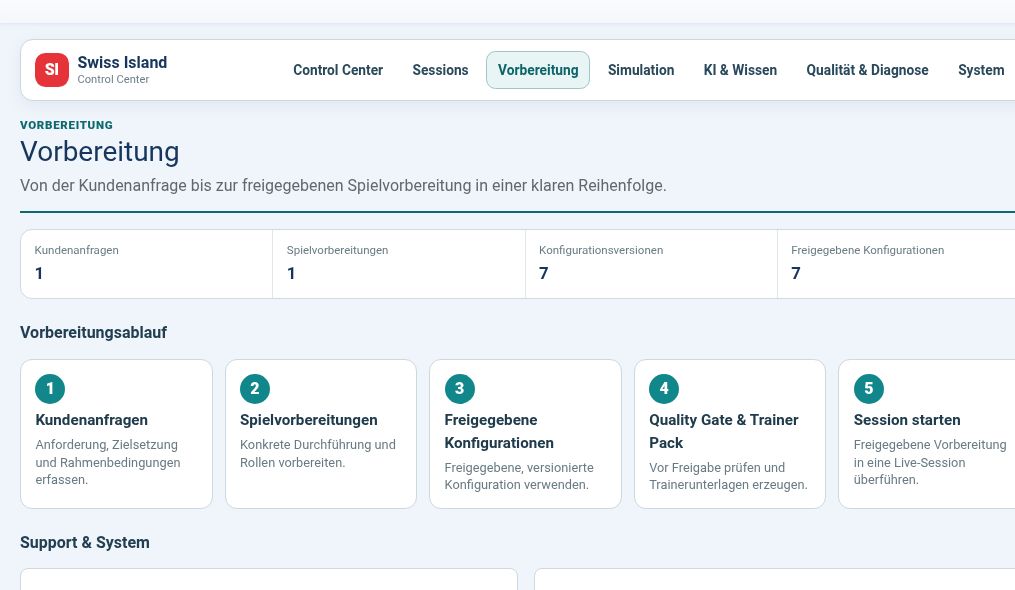
The starting point is the client’s and trainer’s requirements: What should participants experience, practise and reflect on? Objectives, conditions, roles and intended outcomes are captured, reviewed and translated into an approved configuration.
What can be configured?
- learning, development and transfer objectives
- target group and level of experience
- selected project situations and topics
- role allocation and the mix of human and AI-supported roles
- level of challenge and dynamics
- format, duration and number of rounds
- focus areas for debriefing and workplace transfer
Changing priorities, resource constraints, conflicts, project crises or unclear authority can therefore become deliberate elements of the training.
Which roles can AI take?
AI roles are planned for the Sponsor, Steering Committee and Contractors/Sub Contractors. Finance and Procurement are in preparation. Depending on the training requirements, roles can be assigned to people or AI and combined to suit the group.
The Swiss Island map remains at the centre
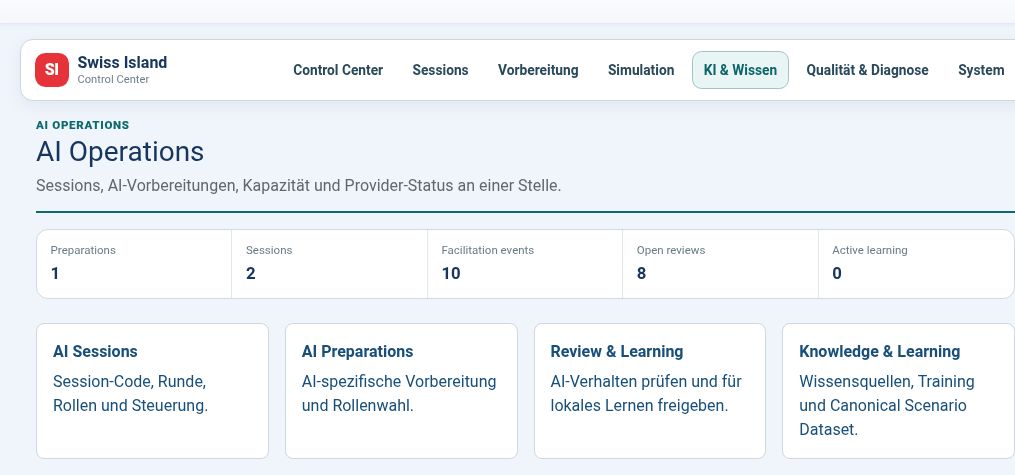
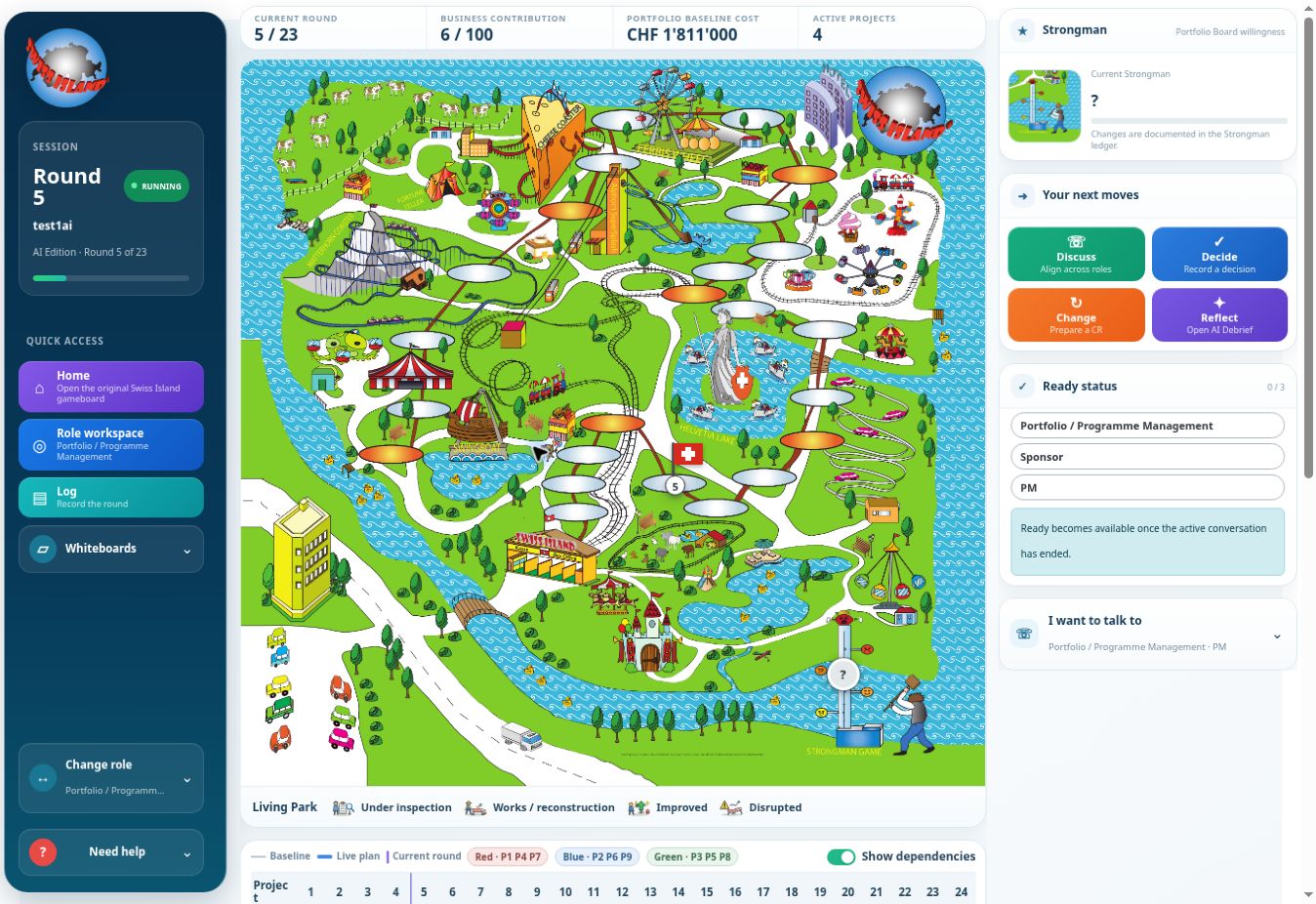
The large walkable map and shared action in the room remain at the heart of Swiss Island. The digital frontend adds role interactions, decisions, documentation and optional AI-supported debriefing.
How does the trainer remain in control?
AI operates within the simulation rules, the current project state and the information available to its role. It cannot change rules or project data on its own. Trainers can review, comment on and improve responses in every round. Only explicitly approved corrections are reused locally in future Swiss Island simulations – they are not used for the general training of external AI models.